Loading…
Local cross-session camera check
Compare two bike-fit camera dates without chasing noise
Select two independently confirmed baselines for the same bike and frozen setup. OpenBikeFit checks protocol and provenance first, then shows a movement difference only when it exceeds both dates' combined observed noise. Video and pose results stay on this device.
2–3 takes per dateNo uploadNo fit score
Visual protocol · two dates
Freeze the frame before comparing movement
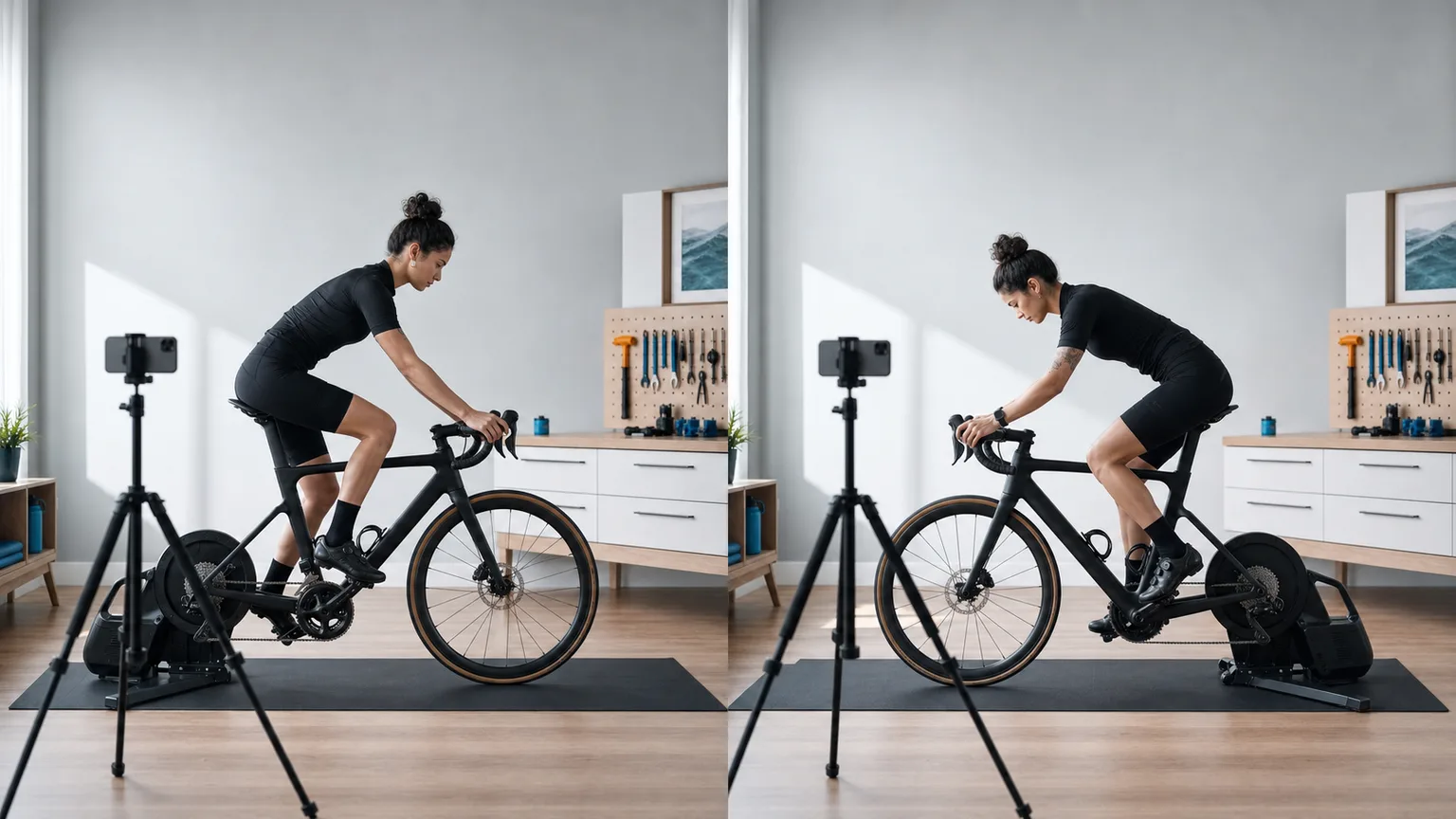
The useful comparison begins with the same saved bike, material setup and declared camera protocol. Only a delta larger than both dates’ combined observed noise is surfaced.
- Same material passport
- Same frame protocol
- Noise-gated delta
Loading private saved sessions from this device…
What gets held constant
A saved setup and a repeatable protocol
A bike name is not enough. New bike-linked baselines freeze the material passport used for that recording: contact coordinates, crank and cockpit dimensions, declared measurement references, angles and component identities. The comparison requires the same local bike profile and the same material fingerprint on both dates. It also requires the same drive-side or non-drive-side view, analysis mode, pose engine, ruleset and measurement protocol.
Each date must already contain a confirmed condition built from two independent takes. If those takes disagree, the existing repeatability workflow asks for a third and never cherry-picks a convenient pair. Legacy sessions without frozen setup proof remain visible, but this tool asks for a fresh baseline instead of guessing.
A successful comparison is reproducible on this browser without creating another data record. The selected local session IDs are kept after the URL fragment only, so the pair can survive a reload without sending angles, passport values or fit inputs in the page request. Deleting either source fit immediately removes the data needed for that comparison; the page then returns to a recoverable selection state.
How the result is calculated
Four movement metrics, one neutral threshold
OpenBikeFit compares the confirmed condition centres for knee at the bottom of the stroke, hip at the top, elbow through the cycle and trunk through the cycle. For each metric, the two conditions' observed noise is combined in quadrature. A delta is labelled only as “beyond observed noise” when its absolute size is larger than that combined threshold; otherwise it stays “within observed noise.”
The result deliberately does not reuse an “improved” or “worsened” target-band verdict. With an unchanged saved setup, a difference can come from day-to-day movement, phone position, cadence, hand placement, fatigue, clothing, lighting or model error. The tool detects a difference; it does not claim why it happened.
Before the second date
Repeat the real recording conditions
- 1. Keep the bike setup unchanged. Do not compare across a saddle, crank, cockpit or contact-point change in this workflow; use the in-session adjustment re-check for that.
- 2. Recreate the view. Put the phone on the same side, near the same height, distance and perpendicular orientation. The software verifies the declared protocol, not physical tripod coordinates.
- 3. Pedal naturally and consistently. Use the same trainer context, similar cadence, normal hand position and enough clean cycles for both takes.
- 4. Stop on red flags. Sudden, severe, progressive or off-bike symptoms still halt autonomous fitting. A cross-session graph is not a medical assessment.
Need the first confirmed date?
Start a guided fit, link the exact local bike, pass the safety and camera-quality checks, then confirm the baseline with an independent second take. Return here after a later session with the same saved material setup.